

Table Mountain
Flora and Fauna
Meet the Plants and Animals of Table Mountain
Table Mountain is home to some of the most remarkable natural biodiversity in the world. From its striking rock formations to its rich variety of plant and animal life, the mountain offers far more than incredible views, it is a living, breathing ecosystem millions of years in the making. Hiking any of Table Mountain’s trails gives you the chance to experience this indigenous flora and fauna firsthand, and no two hikes offer quite the same sights.
Flora and fauna refer to the plant and animal life found across the mountain. Some species occur throughout South Africa, while others exist nowhere else on Earth but on Table Mountain’s slopes. Due to the rarity of many of these species, careful conservation is essential, and the establishment of Table Mountain National Park has played a major role in protecting this unique environment for generations to come.


The Animals of Table Mountain
Back in the 1800’s and before that, Table Mountain was no stranger to big animals like lions, antelope, and hippos. They started fading as years went by, with the last lion spotted on the mountain is approximately 1802. There are a couple of animals that are waiting to make an appearance on one of your hiking Table Mountain adventures. They may include the:
Table Mountain’s animal life has changed significantly over the centuries. Back in the 1800s, the mountain was home to much larger wildlife, including lions, antelope, and even hippos. The last lion sighting on the mountain was recorded in approximately 1802. While these larger animals are long gone, Table Mountain remains home to a fascinating range of wildlife that hikers may encounter along the trails.
Reptiles
Table Mountain is home to a variety of lizards, including the black girdled lizard and the Cape skink. More than 20 species of snake have also been recorded on the mountain, including venomous species such as the Cape cobra, boomslang, puff adder, berg adder, and rinkhals.
Antelope
The Klipspringer, meaning rock jumper, is a small and rarely seen antelope first identified in the 1700s by German zoologist Eberhard Wilhelm. Eland can also be found within the safety of Table Mountain National Park.
Common Birds
Along the mountain’s fynbos covered slopes and forested patches, hikers have a good chance of spotting a variety of birdlife on almost any hike. The Cape sugarbird is one of the most iconic and frequently seen species, closely tied to the protea flowers it feeds from. Other common sightings include the somber bulbul, olive thrush, Cape batis, dusky flycatcher, paradise flycatcher, African olive pigeon, cinnamon dove, orange breasted sunbird, and Cape siskin.
Rare Birds and Birds of Prey
Table Mountain’s cliffs and higher altitude areas are also home to an impressive range of birds of prey, a real highlight for keen birdwatchers. Keep an eye on the skies for Verreaux’s eagle, jackal buzzard, steppe buzzard, rock kestrel, and peregrine falcon, all regularly seen soaring above the mountain. The African harrier hawk, known locally as the gymnogene, and the booted eagle, a summer visitor, add further variety. Rarer sightings include the black sparrowhawk, a relatively recent arrival to the peninsula, and small numbers of the elusive European honey buzzard, a highly sought after migrant seen only between November and April.
Tahr
Table Mountain’s population of Himalayan tahr, a goat like creature, descended from animals that escaped a nearby zoo in the 1930s. Since then, their numbers have grown as they feed on the mountain’s fynbos. For the sake of preserving this rare vegetation, authorities have considered relocating the tahr population in the past.
The Dassie
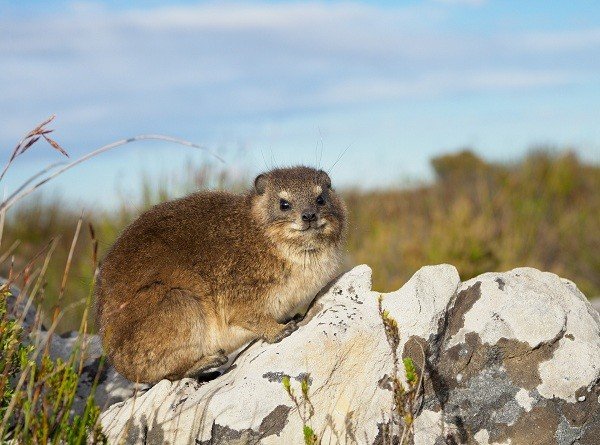
The dassie, or rock hyrax, is Table Mountain’s most commonly spotted animal, often seen sunning itself on rocks along trails such as Lion’s Head. Despite resembling a large guinea pig, its closest living relative is actually the elephant, an evolutionary link that often surprises hikers.
Elusive and Nocturnal Wildlife
Several other mammals call Table Mountain home, though most are nocturnal or highly elusive, making sightings a rare treat for hikers. The caracal, a striking wild cat with tufted ears, is one of the most sought after and secretive residents of the mountain, mostly active at night and rarely seen during the day. One particular caracal, nicknamed Hermes by researchers from the Urban Caracal Project, has become something of a local celebrity after being spotted more frequently than any other caracal on the mountain, including a famous appearance at the summit itself.
Other nocturnal and rarely seen species include the Cape clawless otter, Cape fox, genet, and porcupine, along with the Cape grey mongoose. Most of these animals are active primarily at night, so while direct sightings on a daytime hike are uncommon, keep an eye out for signs of their presence along the trails, from tracks and burrows to the occasional rustle in the fynbos.
The Table Mountain Ghost Frog
One of Table Mountain’s most remarkable, and rarely seen, residents is the Table Mountain ghost frog. This critically endangered amphibian is found nowhere else on Earth, restricted to just a handful of fast flowing perennial streams on the mountain’s eastern and southern slopes. It is one of only two vertebrate species endemic to the entire Cape Peninsula.
The ghost frog earns its name from its pale, almost translucent underside and its elusive, secretive nature, spending most of its time hidden beneath submerged rocks and only emerging at night to feed. Its genus name, Heleophryne, is Latin for “the one who is afraid of the sun.” Remarkably, the species was first recorded in Skeleton Gorge on the mountain’s eastern slopes, the very route our Skeleton Gorge hike follows today, making it a rare and special encounter for any hiker lucky enough to spot one.
The Animals of Table Mountain
Table Mountain hosts an extraordinary variety of plant species, home to more than 2,200 different species in total, many of which are endemic, found nowhere else in the world. Table Mountain National Park is considered the richest floristic site in the world for its size, and forms part of the Cape Floristic Region, a UNESCO World Heritage Site.
Fynbos
Fynbos, meaning “fine bush” in English, is the most dominant and iconic vegetation type on Table Mountain. It consists of four main plant groups: proteas, ericas, restios, and geophytes. Fynbos is a fire adapted vegetation type that has developed over millions of years, with certain species requiring periodic fires to stimulate seed production and dispersal. Some fire adapted species, such as the fire lily, only flower after being stimulated by smoke, meaning they may not bloom for years at a time, only to burst into striking red flower after a fire has passed through. Some fynbos species date back more than 60 million years.
Fynbos and Its Pollinators
With relatively few animal pollinators available in this harsh, nutrient poor environment, fynbos plants have evolved extraordinary and highly specialized ways of attracting attention. The Cape sugarbird, a species closely tied to fynbos survival, can visit as many as 300 protea flowers in a single day, while orange breasted sunbirds have evolved long, curved beaks perfectly shaped to match the tubular flowers of certain Erica species. Roughly 80% of all Erica species rely on insects such as beetles, flies, bees, and moths for pollination, while some plants have even evolved to briefly trap their pollinators inside the flower to ensure pollen is successfully collected or deposited. This intense competition for pollinators is considered one of the key evolutionary forces behind fynbos becoming one of the most diverse plant communities on Earth.
The Pride of Table Mountain
Among Table Mountain’s most celebrated flowers is Disa uniflora, better known as the Pride of Table Mountain. This striking red orchid grows in wet, inaccessible spots along streams, waterfalls, and seeps, flowering between December and March, and is considered by many enthusiasts to be one of the most beautiful orchids in the world. It relies entirely on a single pollinator, the mountain pride butterfly, which is drawn specifically to its vivid red color. The flower is so iconic that it has become an emblem of the region, appearing on the badges of the Mountain Club of South Africa and the Western Province rugby team.
Proteas
Proteas are among the most recognizable and celebrated plants in the fynbos family, and Table Mountain is home to several striking species. The king protea, South Africa’s national flower, is the largest of the family, with a bold, spherical flower head that can grow up to 30 centimeters across. Beyond the king protea, Table Mountain hosts numerous sugarbush varieties, many of which flower throughout the winter months, adding vibrant color to the slopes even in the mountain’s cooler, wetter season.
Indigenous Forest
The mountain’s vegetation varies dramatically depending on which side you are hiking. The western slopes receive more direct sunlight throughout the day and are drier, producing smaller, shrub like vegetation. The eastern slopes, by contrast, are shaded for much of the day and considerably wetter, home to streamlets, waterfalls, and seeps that support lush indigenous forest.
This extra moisture largely comes from the mountain’s famous “Tablecloth,” the thick layer of cloud that forms when the southeasterly wind pushes moisture laden air in from the Atlantic against the eastern slopes. Forced to rise, this air cools and condenses into cloud, which then blows over the summit and dissipates on the western side. In any given year, this cloud precipitation on the summit plateau is nearly double the rainfall the mountain receives, making it a vital, ongoing water source for the eastern slopes’ forests, streams, and unique plant life. Much of this forest was originally planted when timber was needed for construction, and hikes such as Skeleton Gorge showcase this lush, moisture rich side of the mountain beautifully.
Afromontane Forest
Afromontane forest grows in the higher rainfall areas along parts of the mountain’s eastern slopes. This dense, moisture loving forest type thrives in the cooler, sheltered conditions found on this side of the mountain.
Protected and Endangered Vegetation Types
Hiking on Table Mountain may introduce you to several distinct and protected vegetation types, including Peninsula Sandstone Fynbos (endangered), Peninsula Granite Fynbos (critically endangered), Peninsula Shale Renosterveld, and Afromontane forest. In the years before conservation efforts began, Table Mountain lost several plant species to fires, human influence, and erosion, which is part of why these vegetation types receive such careful ongoing protection today.
Threats to Table Mountain’s Flora
Invasive alien plant species remain one of the greatest threats to Table Mountain’s biodiversity. Species such as pine, eucalyptus, wattle, Port Jackson, and hakea were originally introduced during the colonial era for timber and firewood, and have since spread aggressively across the mountain, competing with indigenous fynbos for water, nutrients, and space. These fast growing trees also disrupt local hydrology, destabilize riverbanks, and can significantly worsen wildfires, some alien species burn with far greater intensity than fynbos, allowing fires to spread further and burn hotter than they otherwise would.
Ongoing removal programs continue in an effort to protect Table Mountain’s unique plant life for future generations. Dedicated volunteer groups work alongside Table Mountain National Park to clear invasive vegetation, having treated well over a million alien plants across the park in recent years alone. This work remains essential, protecting not only the mountain’s rare and endemic fynbos, but the wider ecosystem, water supply, and communities that surround it.
Kirstenbosch National Botanical Garden
Back in the 1800’s and before that, Table Mountain was no stranger to big animals like lions, antelope, and hippos. They started fading as years went by, with the last lion spotted on the mountain is approximately 1802. There are a couple of animals that are waiting to make an appearance on one of your hiking Table Mountain adventures. They may include the:
At the foot of Table Mountain’s eastern slopes, right where the Skeleton Gorge hike begins, lies Kirstenbosch National Botanical Garden, widely regarded as one of the great botanical gardens of the world. Established in 1913, Kirstenbosch was the first botanical garden anywhere to be dedicated specifically to a country’s indigenous flora, a philosophy that was ahead of its time, and one it continues to champion today.
Spanning 528 hectares, Kirstenbosch merges seamlessly into the natural fynbos and forest of Table Mountain itself, showcasing more than 7,000 plant species from across South Africa’s unique biomes. In 2004, the Cape Floristic Region, including Kirstenbosch, was declared a UNESCO World Heritage Site, recognition of the extraordinary botanical significance of this landscape.
Kirstenbosch exists, in many ways, because of Table Mountain’s own remarkable flora. Its location at the base of the eastern slopes was chosen specifically to protect and showcase the indigenous fynbos and forest found on the mountain above it, making a visit here a fitting extension of any hike through Table Mountain’s eastern ravines.
Experience It for Yourself
The best way to truly appreciate Table Mountain’s flora and fauna is to see it firsthand. Whether you are winding through the forested slopes of Skeleton Gorge, spotting dassies along Lion’s Head, or taking in the fynbos covered ridges of Kasteelspoort, every trail offers its own unique introduction to this remarkable ecosystem. With so much to see, one hike is never quite enough.


